


WALNUT CREEK, CA — Stand at the corner of North Main Street and Mt. Diablo Boulevard on a Saturday afternoon in 2026, and you’ll see a city in full motion: shoppers weaving through Broadway Plaza, diners on restaurant patios, families walking dogs past public art installations. It’s a scene that feels both thoroughly modern and deeply rooted — a downtown that has spent 175 years reinventing itself without losing its sense of place. It started with two men: William Slusher, who settled along the creek in 1849, and Milo Hough, who built the town’s first permanent structure and is remembered as its founder.
The story of how Walnut Creek got here is the story of the American West in miniature: indigenous land, Mexican ranchos, Anglo settlement, agricultural booms, suburban expansion, and the ongoing tension between growth and identity. For a city that now anchors the Interstate 680 corridor between the Bay and the Delta, the path from walnut orchards to a luxury shopping plaza was neither straight nor inevitable.
The Rancho Era: Land Grants and the First Settlers
Before it was Walnut Creek, the land belonged to the Bay Miwok people, specifically the Saclan tribe, who lived throughout what is now Contra Costa County. Spanish colonization in the late 18th century disrupted indigenous communities, but it was Mexican independence in 1821 that reshaped the region through a system of massive land grants known as ranchos.
In 1834, the Mexican government granted Rancho Arroyo de las Nueces y Bolbones — translating roughly to “Ranch of the Walnut Creek and Bolbones” — to Juana Sánchez de Pacheco. The rancho encompassed more than 17,000 acres stretching across what is now Walnut Creek, Pleasant Hill, and portions of Lafayette. The name came from the walnut trees that lined the creek running through the property, planted by early Spanish missionaries or, in some accounts, naturally occurring California black walnuts that thrived in the riparian corridor.
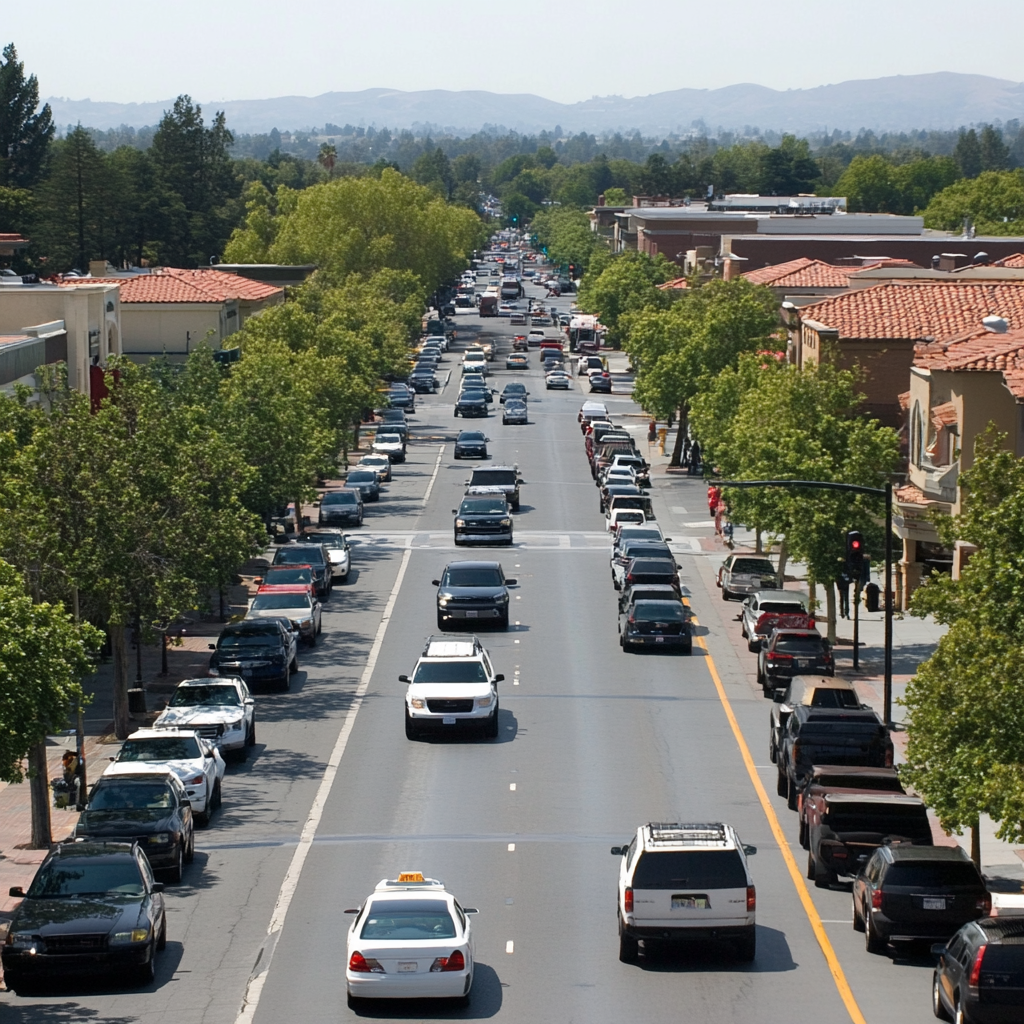
After California joined the United States in 1850, American settlers began arriving. The first Anglo settler in the area was William Slusher, who built a small dwelling on the bank of the creek in 1849. But it was Milo Hough, arriving in 1855, who built the first permanent structure and is widely credited with founding the community that would become Walnut Creek. Hough settled near what is now the intersection of Mt. Diablo Boulevard and North Main Street — ground zero for the downtown you see today.
Da Mayor’s Take
Two men, two arrivals, one claim to the credit. Milo Hough built the first permanent structure, so he gets the plaque and the title of founder. William Slusher got here five years earlier and gets a footnote. That may be the most Walnut Creek thing about the whole story — even the founders had to compete for the good corner.
The Agricultural Century: Walnuts, Pears, and the Railroad
The arrival of the San Ramon Valley Railroad in 1891 transformed Walnut Creek from a remote farming outpost into a connected agricultural hub. The railroad linked Walnut Creek to the Southern Pacific line in Avon (near present-day Martinez), giving local farmers a way to ship walnuts, pears, grapes, and other crops to Bay Area markets and beyond.
Why “Walnut Creek”?
The name comes from the Arroyo de las Nueces — “Walnut Creek” in Spanish. The creek itself, which runs through what is now Civic Park and downtown, was lined with California black walnut trees that served as a landmark for early travelers. The anglicized name “Walnut Creek” was formally adopted when the post office was established in 1862.
For the next half-century, Walnut Creek remained a quiet agricultural community. The population at the turn of the 20th century was just a few hundred people. Orchards stretched across the valley floor, and Mt. Diablo loomed as the region’s defining geographic feature. The town incorporated in 1914 with roughly 500 residents, and for decades, “downtown” meant a handful of shops, a post office, and the train depot along what is now North Main Street.
| Year | Milestone | Significance |
|---|---|---|
| 1834 | Rancho Arroyo de las Nueces granted | 17,000-acre Mexican land grant established |
| 1849 | William Slusher settles on the creek | First known Anglo settlement |
| 1855 | Milo Hough arrives | Built first permanent structure; considered town founder |
| 1862 | Post office established | Name “Walnut Creek” formally adopted |
| 1891 | Railroad arrives | Connected farmers to Bay Area markets |
| 1914 | City incorporation | Population: ~500 |
| 1950 | Post-war boom begins | Orchards give way to subdivisions |
| 1973 | BART opens | Direct rail link to San Francisco |
| 1990 | Lesher Center opens | Arts and culture anchor for downtown |
| 2016 | Broadway Plaza expansion | Made WC an East Bay retail hub |
Post-War Transformation: Orchards to Suburbs
Everything changed after World War II. The G.I. Bill, the construction of Interstate 680, and the explosive growth of the Bay Area economy turned Contra Costa County into one of the fastest-growing regions in California. Between 1950 and 1970, Walnut Creek’s population surged from roughly 2,400 to more than 39,000 as walnut orchards and pear farms were bulldozed to make way for subdivisions, schools, and shopping centers.
The opening of Broadway Shopping Center in 1951 marked the beginning of downtown’s retail destiny. Located at the corner of North Broadway and Mt. Diablo Boulevard, it was one of the first suburban shopping centers in the Bay Area — a predecessor to the open-air luxury plaza that now anchors downtown. The mall expanded repeatedly over the following decades, eventually becoming Broadway Plaza, which today houses more than 80 retailers including Nordstrom, Apple, and a collection of luxury boutiques that would have been unthinkable in the walnut-orchard era.
The arrival of BART in 1973 connected Walnut Creek directly to San Francisco and Oakland and made it a commuter hub. Residential and commercial development followed. The station, located at Ygnacio Valley Road and Interstate 680, became a catalyst for growth around the downtown core.
The Modern Era: Dining, Arts, and Identity
The opening of the Lesher Center for the Arts in 1990 gave Walnut Creek a cultural anchor that went beyond shopping. Named for Dean and Margaret Lesher, the center houses the 800-seat Hofmann Theatre, the 300-seat Margaret Lesher Theatre, and the Bedford Gallery, which hosts rotating visual art exhibitions. Center REP, the resident professional theatre company, produces a full season of musicals and plays that draw audiences from across the Bay Area.
On downtown’s restaurant row — a stretch of North Main Street and Locust Street — the dining scene has evolved from suburban steakhouse fare to a genuinely competitive culinary landscape. Restaurants like Va de Vi, Telefèric Barcelona, and the recently opened Mensho Tokyo Ramen reflect a city that now punches above its weight class. The Walnut Creek Downtown Association has championed this evolution, programming events from First Wednesday street fairs to the annual Walnut Creek Art & Wine Festival — one of the largest community events in the East Bay.
The Urban Limit Line: A Defining Choice
Contra Costa County’s Urban Limit Line, which went before voters in June 2026, is the latest chapter in a land-use debate that goes back to the rancho era. The line draws a hard boundary between developable land and open space, preserving the agricultural and natural areas that once defined the entire region. For Walnut Creek, the limit line means the city’s boundaries are effectively fixed — growth will happen up, not out, reinforcing the downtown-centric identity that has emerged over the past half-century.
What History Means for Today
Understanding Walnut Creek’s history isn’t just an academic exercise — it helps explain the tensions and opportunities the city faces in 2026. The debate over short-term rentals on Mandarin Lane, the debate over extending downtown alcohol service hours, the council’s wrestling match with hiring shortages and fee structures — all of these are downstream of a city that has grown from 500 to 70,000 residents in just over a century, transforming from an agricultural outpost into an economic engine for central Contra Costa County.
The walnut orchards are gone, but the creek still runs through downtown. The railroad depot is long since demolished, but BART carries 6,000-plus daily riders through the station. The rancho era is a distant memory, but the land-use battles that defined it — who gets to use this land, and how — remain as relevant as ever. For the fuller arc of that story, from the first orchards to the 2026 skyline, read how Walnut Creek evolved from rancho to retail.
For those interested in exploring more about Walnut Creek’s history, the Walnut Creek Historical Society maintains archives and operates the Shadelands Ranch Historical Museum on Ygnacio Valley Road. The City of Walnut Creek website includes detailed historical resources, and the Walnut Creek Downtown Association provides information on current businesses and events that carry the downtown story forward.



One comment on “William Slusher & Milo Hough: The Founders of Walnut Creek”
Comments are closed.