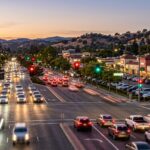
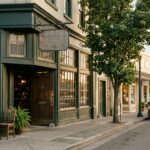


On May 21, 1973, a sleek silver train pulled into a brand-new elevated station at Ygnacio Valley Road and Interstate 680, and Walnut Creek was never the same. The arrival of Bay Area Rapid Transit didn’t just give residents a faster way to reach San Francisco — it rewired the city’s economic DNA, transforming a former agricultural town into one of the East Bay’s most desirable places to live, shop, and do business. More than five decades later, the ripples of that single rail connection continue to shape everything from downtown development to the skyline you see today.
BART didn’t invent Walnut Creek. The city had already been growing steadily in the postwar years, with the opening of Broadway Shopping Center in 1951 and a population that quadrupled from 2,460 in 1950 to nearly 10,000 by 1960. But BART accelerated everything — pushing development timelines forward by decades, attracting office towers and retail investment that would have been unthinkable for a Contra Costa suburb in the 1970s, and laying the track — literally — for the downtown you walk through today.
Before the Train Came
It’s hard to imagine now, with Broadway Plaza’s 80-plus retailers and six-figure foot traffic, but mid-century Walnut Creek was still defined by what it had always been: orchards, open space, and a small-town pace. The Southern Pacific Railroad had arrived in 1891, connecting local farmers to Bay Area markets, and by 1914 the town incorporated with roughly 500 residents. But for the next several decades, growth was modest. Even the post-World War II housing boom, which sent subdivisions marching across the valley floor, hadn’t yet erased Walnut Creek’s identity as a bedroom community with agricultural roots.
The 1951 opening of Broadway Shopping Center — Contra Costa County’s first major retail destination, anchored by JCPenney, Sears, and Woolworths — signaled the direction the city was heading. But it was still a car-dependent future. Getting to San Francisco required a drive to Oakland or a winding trip across the Bay Bridge. For all its charms, Walnut Creek in the early 1960s was a suburb at the edge of the region’s economic gravity, not a participant in it.
The Fight to Build BART
The idea of a regional rapid transit system for the Bay Area had been kicking around since 1946, when business and civic leaders began meeting informally to discuss the mounting post-war traffic congestion on the Bay Bridge. In 1951, the California Legislature created the San Francisco Bay Area Rapid Transit Commission to study the problem, and by 1957 the Commission recommended forming a five-county transit district. The Legislature acted that same year, creating the BART District — initially including Alameda, Contra Costa, Marin, San Francisco, and San Mateo counties.
But the plan nearly collapsed before it began. San Mateo County withdrew in December 1961, citing the high cost and adequate existing Southern Pacific commuter service. Marin County followed in early 1962, its small tax base unable to absorb the projected costs — plus an engineering controversy over whether trains could safely cross the Golden Gate Bridge. What remained was a three-county system: San Francisco, Alameda, and Contra Costa.
The revised plan went to voters in November 1962. It needed 60 percent approval. It got 61.2 percent — a margin so thin that one business executive was reported to have said, “If I’d known the damn thing would have passed, I’d never have supported it.” The $792 million bond issue was, at the time, the largest single public works project ever undertaken by local citizens in American history.
| Year | Milestone | What It Meant for Walnut Creek |
|---|---|---|
| 1946 | BART concept born at civic leader meetings | First recognition that Bay Bridge congestion demanded a transit solution |
| 1957 | BART District formed; Contra Costa included | Walnut Creek secured a place on the system map |
| 1962 | $792M bond measure passes (61.2%) | System funded; Concord Line route through I-680 corridor confirmed |
| 1964 | Diablo Test Track ground-breaking (June 19, LBJ presides) | 4.4-mile test segment built between Concord and Walnut Creek |
| 1973 | Walnut Creek station opens (May 21) | Direct rail connection to San Francisco and Oakland begins |
| 1985 | “Golden Triangle” office towers built near station | Height restriction law passed in response to rapid development |
| 2012 | Transit Village plans approved | Mixed-use TOD replaces surface parking; 900-space garage opens 2019 |
May 21, 1973: The Station Opens
Walnut Creek station was one of the original BART stations, opening as part of the MacArthur-to-Concord extension — the first segment of what is now the Yellow Line. The station name had been approved by the BART Board back in December 1965, and it opened alongside Lafayette, Pleasant Hill, and Concord stations in a single expansion that brought rapid transit deep into Contra Costa County for the first time.
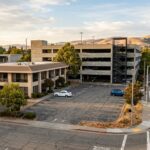
The station was designed by the architecture firms Gwathmey, Sellier & Crosby and Joseph Esherick & Associates, with an elevated layout featuring two side platforms perched above the fare lobby. It was conceived as a suburban park-and-ride stop — the assumption being that most riders would drive to the station, park, and take the train into the city. That assumption held for decades, and the station’s sprawling surface parking lots shaped the landscape around Ygnacio Valley Road for nearly half a century.

The first passengers on May 21, 1973 boarded trains that could hit 70 miles per hour between stations, carrying them from Walnut Creek to downtown San Francisco in roughly 35 minutes — a trip that, by car during rush hour, could take well over an hour. For the first time, a Walnut Creek address came with a direct, reliable pipeline to the Bay Area’s economic core.
The BART Effect: Office Towers, Retail, and the Golden Triangle
The economic impact was neither subtle nor slow. Within a decade of the station opening, Walnut Creek’s downtown had begun a transformation that would accelerate through the 1980s and beyond. The most visible symbol of the BART-driven boom was the “Golden Triangle” — a cluster of ten-story office buildings that rose near the station in 1985, marking Walnut Creek as a legitimate business hub rather than just a commuter suburb.
The office development was so rapid, in fact, that it triggered a political backlash. In March 1985, Walnut Creek voters passed a height restriction law to limit further large-scale development, a direct response to the pace of change that BART had unleashed. The measure reflected a tension that still defines Walnut Creek today: the desire to grow as an economic center without losing the suburban character that made the city attractive in the first place.
Broadway Plaza: Built on BART’s Back
Broadway Shopping Center opened in 1951 with 38 stores, but its transformation into the luxury retail destination you see today — with Nordstrom, Apple, Neiman Marcus, and more than 80 tenants — was fueled by the customer base that BART delivered. The opening of the Walnut Creek station in 1973 coincided with the shopping center’s first major expansion, adding a new Bullock’s department store (later Nordstrom) that same year. By connecting downtown directly to the region’s transit network, BART transformed Broadway Plaza from a local shopping center into a regional retail anchor that now draws visitors from across the East Bay and beyond.
The retail ecosystem grew in step with the station’s ridership. Downtown restaurants, services, and entertainment venues sprang up to serve not just residents but the growing daytime population of office workers. The Lesher Center for the Arts, which opened in 1990 and now anchors downtown’s cultural scene, was a beneficiary of the broader urbanizing impulse that BART had set in motion two decades earlier.
BART in 2026: Ridership, Recovery, and the Hybrid Work Era
Like every transit system in America, BART was hit hard by the pandemic. Pre-COVID, the Walnut Creek station was one of the busiest in the East Bay outside of San Francisco and Oakland, serving thousands of daily commuters. The shift to hybrid and remote work in 2020 emptied platforms across the system, and recovery has been uneven. By 2025, the station averaged 3,078 weekday riders — a fraction of pre-pandemic volumes — reflecting broader challenges for a system built around the five-day office commute.
But ridership data tells only part of the story. BART has been investing heavily in modernization: the Fleet of the Future cars (now the system’s exclusive fleet), station upgrades including elevator fare gates installed at Walnut Creek in 2022, and aggressive efforts to improve safety and cleanliness. The system’s performance metrics have improved markedly in recent years — as we covered in our May 19 report on BART’s decade-high performance scores — and the agency is increasingly focused on attracting non-commute ridership: weekend travelers, event-goers, and shoppers heading to destinations like downtown Walnut Creek.
The station area itself has undergone a physical transformation that reflects changing ideas about what a BART station should be. The Walnut Creek Transit Village — a phased mixed-use development that replaced surface parking with apartments, retail space, and a 900-space parking garage completed in 2019 — represents a fundamental shift from the original park-and-ride model to transit-oriented development. Where the 1970s station was designed to get people out of their cars and onto trains, the 2020s station is designed to get people out of their trains and into a walkable neighborhood.
What the Track Left Behind
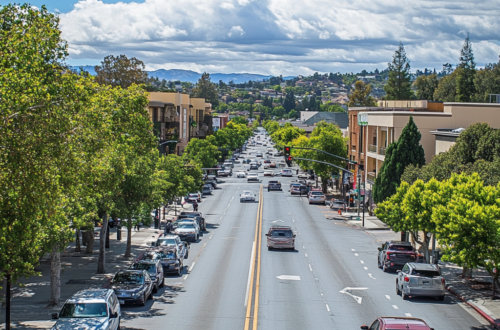
Fifty-three years after that first silver train pulled into the station, it’s worth asking: what did BART actually build in Walnut Creek? The answer is larger than the elevated tracks and concrete platforms at Ygnacio Valley Road. BART built a downtown where one didn’t exist — not from scratch, but by concentrating the economic energy that had been scattered across a sprawling suburb and channeling it into a dense, walkable, commercially vibrant core.
The Walnut Creek of 1973 had roughly 40,000 residents and a modest retail center. The Walnut Creek of 2026 has more than 70,000 residents, a downtown that generates an outsized share of the city’s general fund, and a station area that continues to evolve from a suburban park-and-ride into a genuine urban neighborhood. The orchards are long gone, but the connection that replaced them — the 35-minute train ride to downtown San Francisco — is the thread that runs through every chapter of the city’s modern history.
Not every change has been welcomed by every resident — the height restriction vote of 1985 made that clear — and the city’s relationship with growth remains as complex as ever. But the fundamental fact is hard to dispute: without BART, the Walnut Creek you see today simply doesn’t exist. For better and occasionally for worse, one of America’s most ambitious public transit projects reached a small East Bay suburb in May 1973, and nothing was the same after.
For more on BART’s history, including a detailed timeline and archival materials, visit the BART History page. For current station information, schedules, and parking details, see the Walnut Creek station page. The City of Walnut Creek provides additional historical and planning resources.




One comment on “How BART Changed Everything: The Transit Line That Turned Walnut Creek Into a Destination”
Comments are closed.