




From Rancho to Retail: How Walnut Creek Became the East Bay’s Downtown
Walnut Creek didn’t start as a shopping destination. Before Broadway Plaza, before the restaurants on Main Street, before BART — this was ranchland. The story of how a rural crossroads became one of the Bay Area’s most desirable suburbs is worth knowing, especially if you call it home.
The Land Grant Era (1840s–1860s)
Like much of Contra Costa County, Walnut Creek began as a Mexican land grant. The area was originally part of Rancho Las Juntas, a 13,000-acre grant given to William Welch in 1844. The name “Walnut Creek” itself comes from the Spanish Arroyo de las Nueces — “Stream of the Walnuts” — a reference to the native walnut trees that lined the waterways.
The first American settlers arrived during the Gold Rush era, drawn not by gold but by the fertile valley soil. By the 1850s, the area was known primarily for agriculture: wheat, fruit orchards, and cattle ranching. The arrival of the Southern Pacific Railroad in 1891 connected Walnut Creek to Oakland and San Francisco, slowly transforming it from farmland into a commuter stop.
Postwar Boom: The Suburbs Arrive (1950s–1970s)
Walnut Creek incorporated as a city in 1914, but the real transformation came after World War II. The postwar housing boom, the construction of Interstate 680, and the opening of BART in 1973 turned Walnut Creek into a commuter suburb for San Francisco and Oakland professionals.
Broadway Plaza and the Rise of Retail
Broadway Plaza opened in 1951 as an open-air shopping center — a novel concept at the time. Over the decades, it expanded dramatically, adding a second level, enclosing portions, and attracting luxury anchors like Neiman Marcus (opened 2012) and Nordstrom.
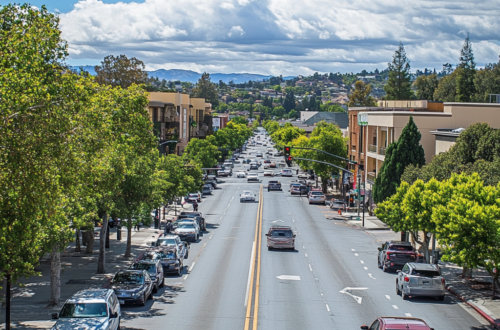
By the 1990s, Walnut Creek had evolved into the retail hub of Contra Costa County. Downtown’s restaurant scene exploded in the 2000s and 2010s, transforming Main Street and Locust Street from quiet corridors into a dining destination that now draws visitors from across the East Bay.
What the Past Means for Today
Understanding Walnut Creek’s history explains a lot about its present. The city’s 25 neighborhoods — from the historic Almond-Shuey district to the relatively newer developments in Northgate — each reflect different eras of the city’s growth. The open space that rings the city (Shell Ridge, Lime Ridge, Acalanes Ridge) isn’t accidental; it’s the result of deliberate preservation efforts dating back to the 1970s.
The downtown you walk through today — the one that generates 28% of the city’s general fund revenue — is the product of 170 years of evolution, from walnut groves to world-class retail. Not bad for a place that started as a railroad stop.
Shadelands Ranch Museum: 2660 Ygnacio Valley Rd — original 1903 ranch house, open for tours
Contra Costa County History Center: 724 Escobar St, Martinez — county-wide archives