








WALNUT CREEK, CA — For one week this fall, fifteen drivers hit something in Walnut Creek and kept going.
That’s not a typo.
Fifteen hit-and-run calls landed in the Walnut Creek Police Department’s daily log between September 15 and September 21, according to the department’s own call data. That works out to a little more than two a day, in a week that saw 521 calls for service overall.
A hit-and-run isn’t just a bent fender. Clip a mirror in a parking lot and drive off, and you’ve committed one. Most are parking-lot dings, not dramatic chases — which is almost more annoying.
The North Main cluster
The worst of it clustered along North Main Street. The 2400 block, the run of auto lots and strip malls south of Ygnacio Valley Road, logged three hit-and-runs in three straight days.

One on the 17th, one on the 18th, one on the 19th. A fourth came in a few blocks north, at the 2800 block, later that same night.
It’s the kind of stretch where cars are always turning in and out, and nobody looks twice at a dented bumper.
Two crashes, one corner
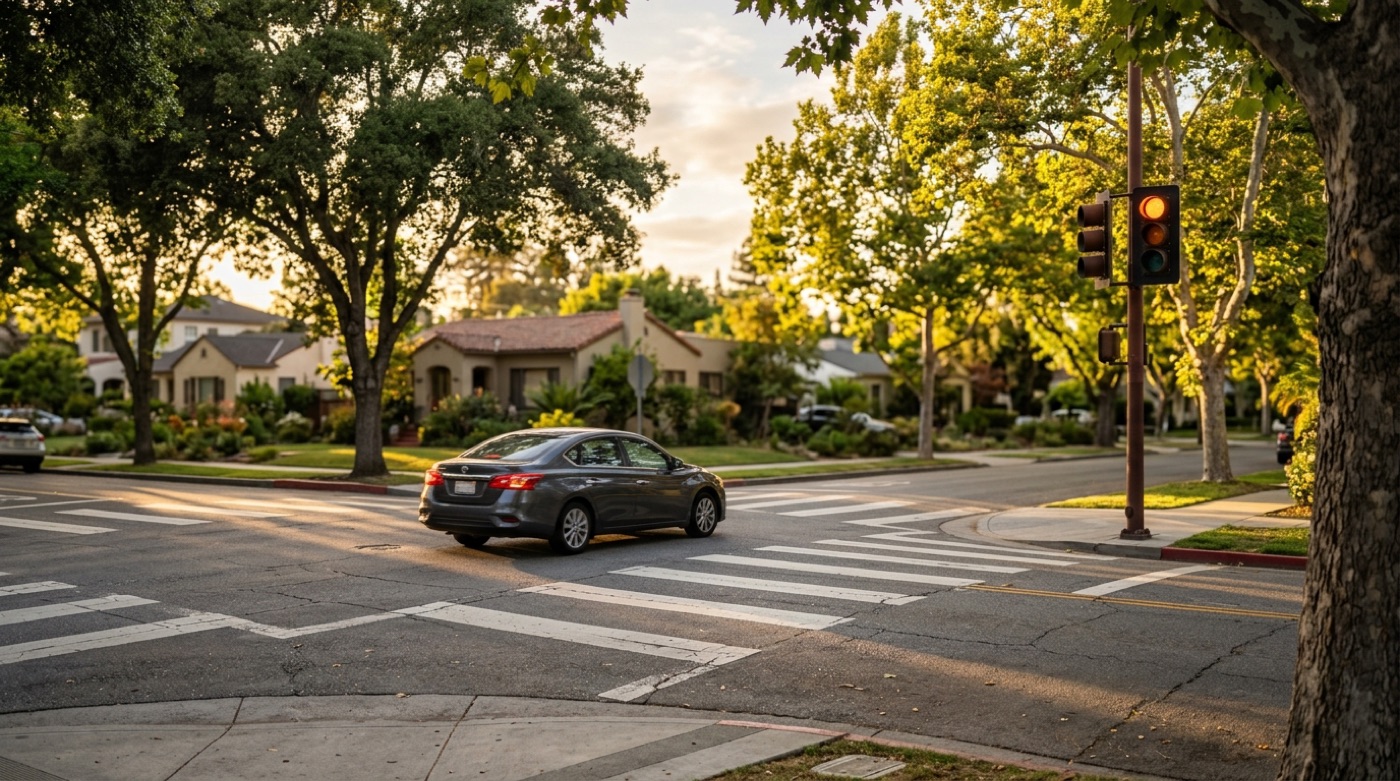
Then there was the strange one. On Saturday, September 20, two hit-and-runs were reported at the same corner, three hours apart. South California Boulevard and Botelho Drive, where the street dips under the freeway.
Two drivers, two crashes, same intersection, same evening.
The log doesn’t connect them. It just lists them, a few lines apart.
Why drivers flee
The log doesn’t say why people flee. It just records that they did.
Drivers who take off usually have a reason they don’t want to be standing around when the other driver calls police. No insurance, a suspended license, a warrant, a couple of drinks.
A suspended license or a lapsed policy is usually the whole story. Hit-and-run is often a paperwork panic, not a heist.
Which doesn’t make it any less expensive for the person who stayed.
California splits the crime in two. Hit-and-run with an injury is Vehicle Code 20001, a “wobbler” that can be charged as a felony.
Someone dies, and it pushes toward four years in prison. Property-only hit-and-run is Vehicle Code 20002, always a misdemeanor.
Either way, leaving is what turns a mistake into a crime.
For the person left next to a dented car, it’s a specific kind of maddening. Your bumper is caved in, the other driver is gone, and now you’re the one on the hook for a deductible.
The Numbers
- 15 hit-and-run calls in seven days (Sept. 15–21)
- 3 at the 2400 block of North Main Street alone, on three straight days
- 2 at South California Boulevard and Botelho Drive on the same Saturday, three hours apart
- 521 total calls for service that week, per the WCPD daily log
What to do in the first ten seconds
If it happens to you, most of the advice happens in the first ten seconds. Try to get the plate, even a partial.
Make, model, color — grab all three.
Look for witnesses, and for the cameras. Doorbell cams, parking-lot cams, and the city’s Flock license-plate readers all catch cars leaving scenes.
Then call it in and don’t chase. If you’re the one who clipped a mirror, leave a note.
The person whose car you hit is probably two doors down.
If the other driver does stop, trade names, numbers, and insurance before anyone leaves. Take a photo of the damage and the plate, not just the scene.
And write your own plate down now. You won’t remember it under stress, and a stranger two doors down may need it.
If You’re Hit — and They Run
- Grab the plate — even a partial — plus make, model, and color.
- Look for witnesses and cameras before the moment fades.
- Call 911 from a safe spot. Do not follow the other driver.
- File a report online or by phone through the WCPD report page.
The paperwork nobody mentions
There’s one more step people forget. California wants an SR-1 report filed with the DMV within ten days, if anyone was hurt or the damage topped $1,000. Even a minor injury counts.
That’s on top of the police report, not instead of it. The DMV’s accident-reporting page walks you through it.
It matters even when the other driver got away. The SR-1 is how the state tracks crash data and keeps your record straight when the insurance claim lands.
The cameras are watching
Walnut Creek runs a network of Flock license-plate readers on its main corridors. A plate — even a partial — is the single most useful thing you can hand police.
The cameras log cars as they pass, which is exactly the kind of breadcrumb that matters after a hit-and-run. Here’s how the license-plate readers work, and where to find the one nearest you.
The daily log is public, too. Anyone can page through it and see what’s been reported on their own block. It’s a good way to know your own street.
Da Mayor’s Take
Here’s the thing about hit-and-runs. They’re mostly slow-speed and low-stakes — right up until the driver leaves. Then it’s a whole different problem.
Verdict: slow down on North Main, and get the plate before you ever need it.
The September tally is a reminder that the busiest street in town isn’t necessarily the most dangerous one. It’s just the one where the most people are.
Hit-and-runs happen to be the part of the log that leaves someone else holding the bill. The bill is rarely small.
Know something I should cover? Reply or DM.


2 Comments on “Walnut Creek Hit-and-Runs: The North Main Cluster and What to Do”
Comments are closed.