


WALNUT CREEK, CA — If you’ve driven through Walnut Creek recently — down Ygnacio Valley Road, along Treat Boulevard, or past Heather Farm Park — there’s a good chance your vehicle was photographed, logged, and entered into a searchable database. You probably didn’t notice. That’s by design.
Walnut Creek is home to approximately 40 FLOCK Safety automated license plate reader (ALPR) cameras, part of a growing network of roughly 300 such devices across Contra Costa County. These AI-powered cameras capture every passing vehicle — not just those connected to a crime — and turn the data into searchable records that law enforcement can query. Here’s how they work, where they are, and what residents should know about the technology watching the roads.
Flock cameras in Walnut Creek: the quick facts
• 40 cameras inside city limits
• Part of a 300-camera network across Contra Costa County
• Capture every vehicle, 24 hours a day
• No facial recognition — plates only
• Find locations on the DeFlock map
What Are FLOCK Cameras?
FLOCK Safety is a privately held surveillance technology company that sells ALPR systems to law enforcement agencies, homeowner associations, and businesses. Unlike traditional speed cameras or red-light cameras that only activate when a violation occurs, FLOCK cameras run continuously — capturing an image of every single vehicle that passes, 24 hours a day.
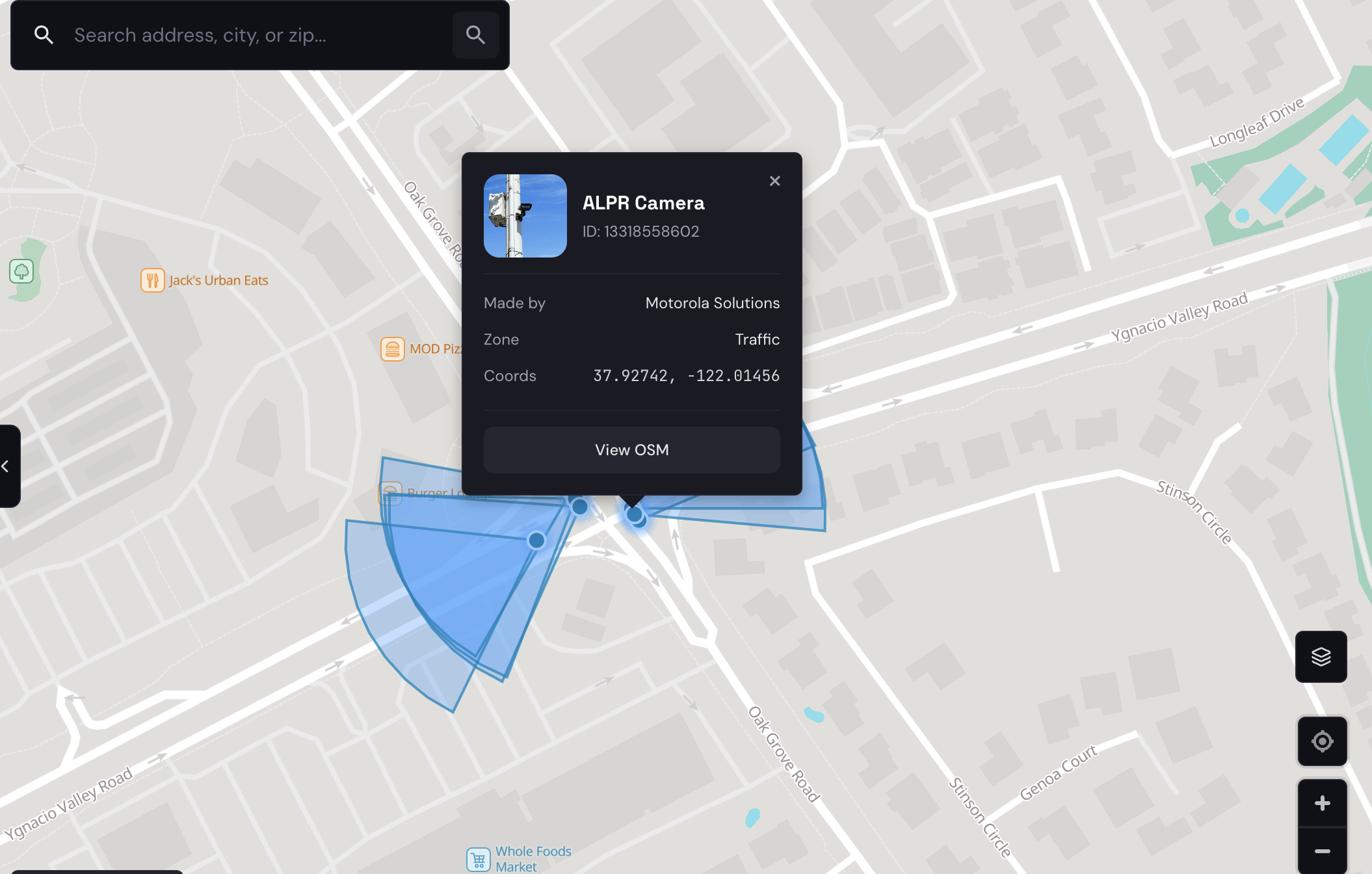
Each FLOCK camera is essentially a solar-powered, AI-equipped camera mounted on a pole. When a car drives by, the system captures:
- License plate number — the primary data point, tied to state DMV records
- Date, time, and GPS location — precisely when and where your vehicle was seen
- Vehicle make, model, and color — identified by computer vision algorithms
- Identifying features — dents, roof racks, bumper stickers, window decals, and even temporary details like a bike rack or a cracked taillight
All of this is converted into searchable data points. An investigator can search not just for a license plate, but for “a white Ford F-150 with a roof rack and a dent on the passenger door” and get results from across the entire FLOCK network.
How Many Are in Walnut Creek?
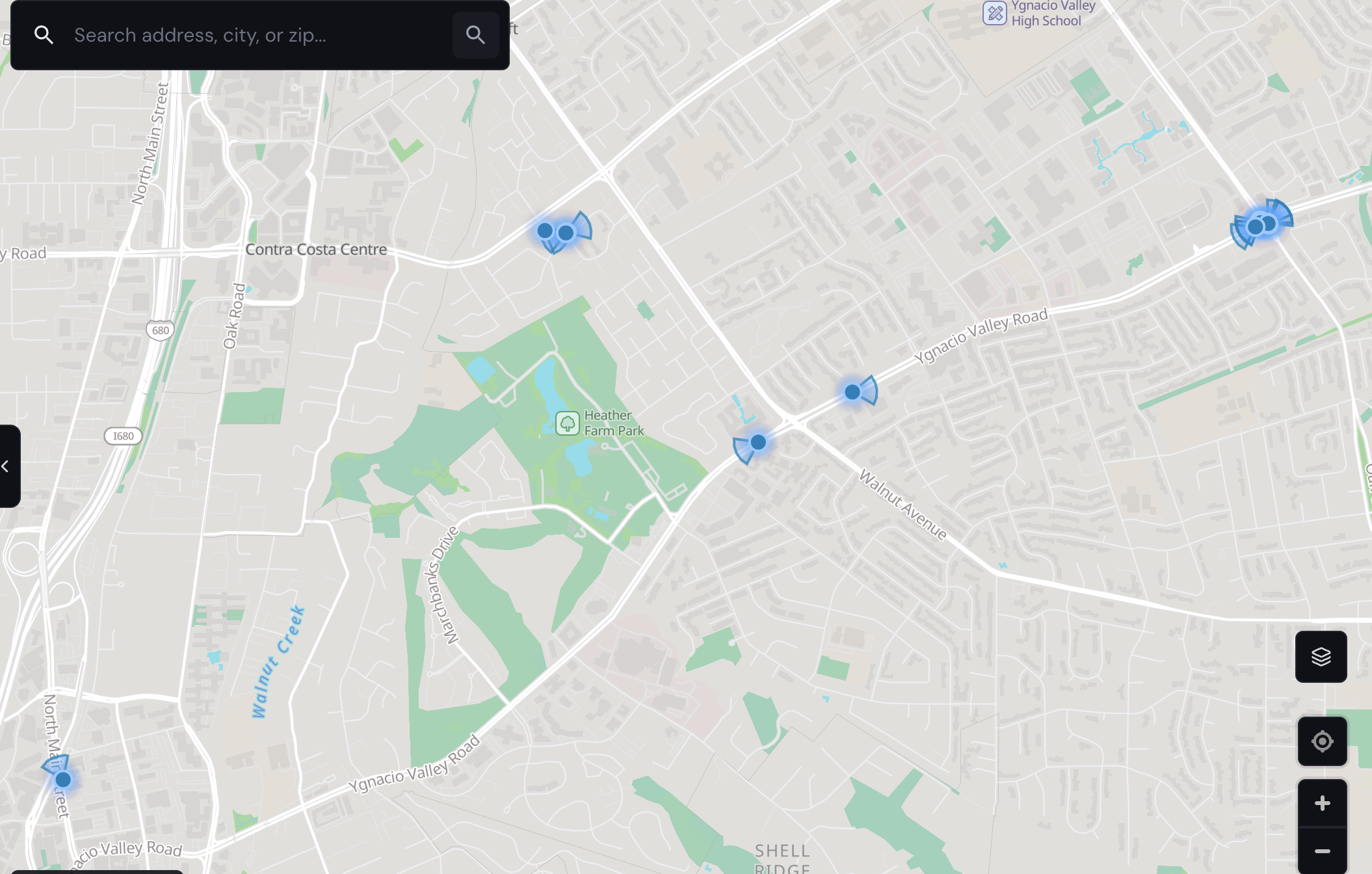
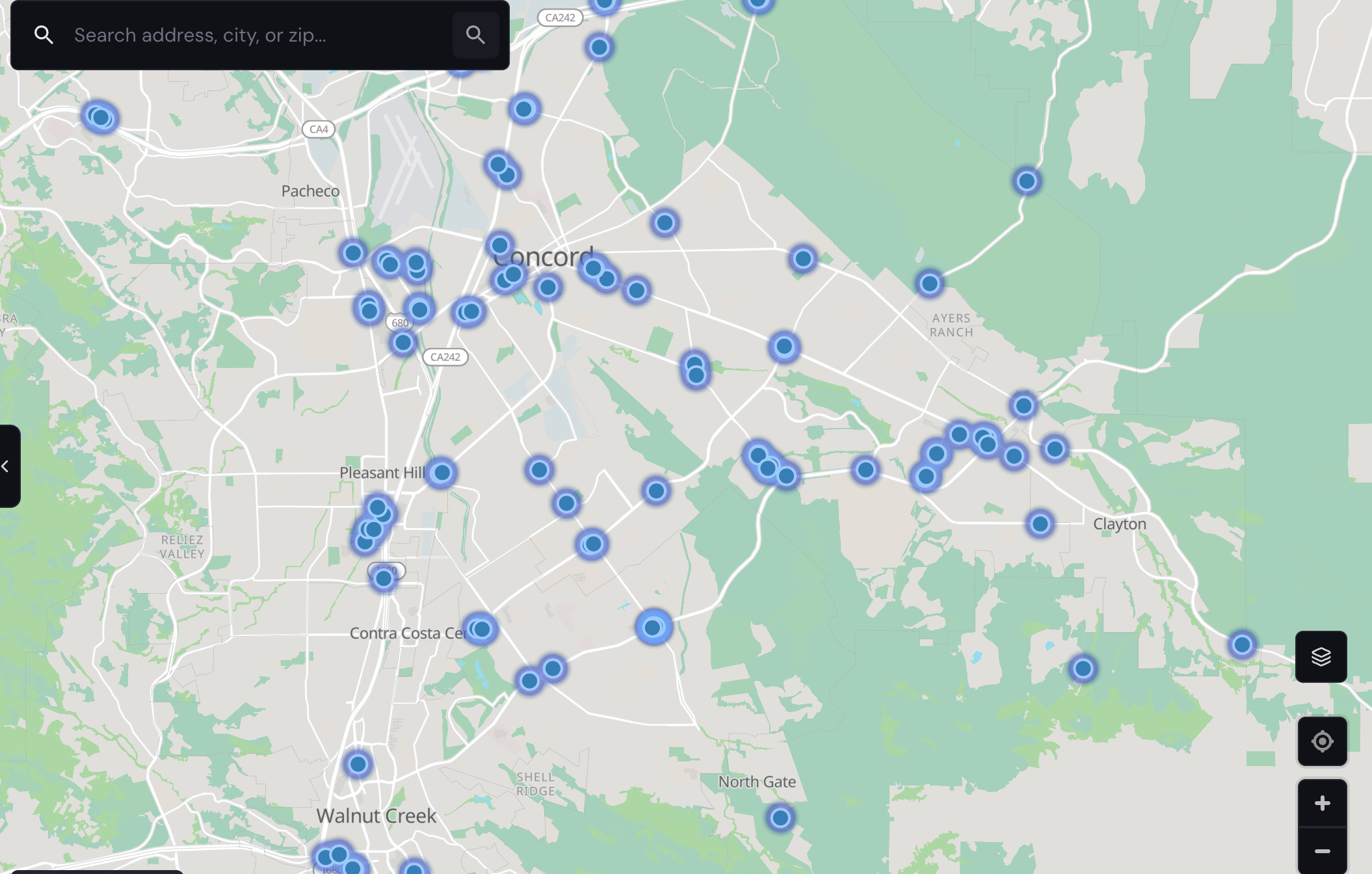
Walnut Creek currently has approximately 40 FLOCK cameras installed within city limits. For context, neighboring Concord has about 50, making Walnut Creek one of the denser nodes in Contra Costa County’s growing FLOCK network of roughly 300 total cameras.
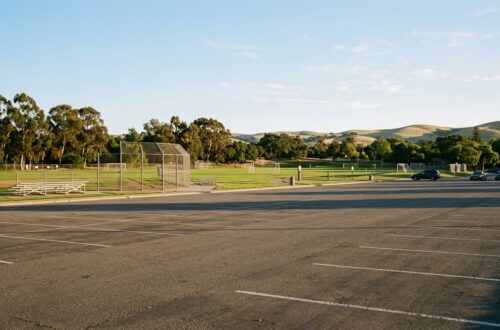
These cameras are concentrated along major traffic corridors — Ygnacio Valley Road, Treat Boulevard, Oak Grove Road, and Bancroft Road are particularly well-covered. You’ll also find clusters near key intersections, shopping districts, and residential entry points. Parks and green spaces like Heather Farm Park and the Pine Creek area are surrounded by camera-monitored roads.
Many residents pass multiple FLOCK cameras during a single trip to the grocery store without ever noticing them. The cameras are designed to be unobtrusive — small, grey boxes on slim poles, easily mistaken for traffic sensors or utility equipment.
Where to See Them: The DeFlock Map
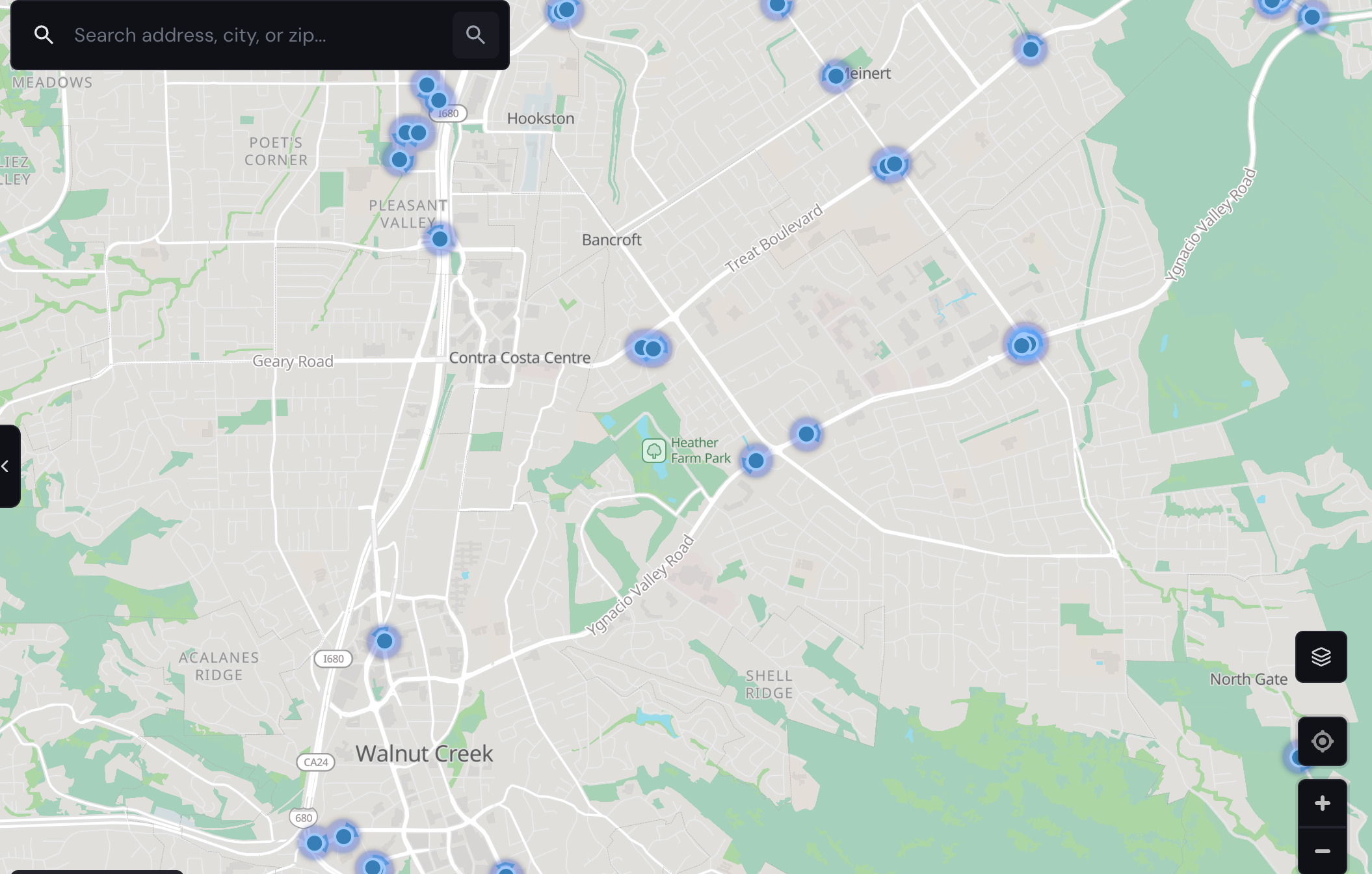
A community-driven project called DeFlock has mapped FLOCK and other ALPR camera locations across the country, with blue markers for each known installation. The interactive map at maps.deflock.org covers Walnut Creek and all of Contra Costa County.
FLOCK Safety has actively attempted to have this map taken down, arguing that revealing camera locations undermines their effectiveness. The DeFlock project maintains that the public has a right to know where they are being surveilled. As of this writing, the map remains online and is regularly updated by volunteers who document new installations.
The Crime-Fighting Argument
FLOCK Safety markets its cameras as essential tools for law enforcement, and police departments that use them point to real results. The core use case is straightforward: when a vehicle connected to a crime — a stolen car, an Amber Alert, a suspect vehicle — passes a FLOCK camera, the system can alert officers in real time.
Walnut Creek Police Department, like many departments in the region, uses ALPR data to investigate property crimes, locate stolen vehicles, and generate leads in cases where a vehicle description is available. FLOCK reports that its network has contributed to a measurable reduction in certain categories of crime in some cities where the cameras are deployed. A year into the program, we checked whether the cameras are actually working.
Supporters argue that license plates are visible in public anyway, and that automated collection simply makes the data more useful for solving crimes. They also note that FLOCK cameras do not capture faces, do not use facial recognition, and are pointed at public roadways — not into homes or backyards.
The Privacy Concerns
Critics — including civil liberties organizations like the Electronic Frontier Foundation (EFF) and the ACLU — raise several concerns about the scale and nature of ALPR networks:
Mass surveillance, not targeted investigation. FLOCK cameras collect data on every vehicle, not just those connected to criminal activity. The overwhelming majority of drivers whose data is captured, stored, and made searchable have done nothing wrong.
Data retention and sharing. FLOCK retains vehicle data, and law enforcement agencies can share access across jurisdictions. A camera installed by the Walnut Creek Police Department could contribute data accessible to agencies hundreds of miles away — and vice versa. This creates a searchable, multi-jurisdictional database of vehicle movements that did not exist a decade ago.
The warrant question. Law enforcement already has powerful tools to track suspects — cell phone location data, for example, generally requires a warrant. ALPR data, by contrast, is often accessed without one because the cameras capture information visible from a public roadway. Privacy advocates argue this creates a loophole: mass, warrantless tracking of individuals’ movements, stored indefinitely, searchable by anyone with database access.
Pattern-of-life analysis. Over time, license plate data can reveal highly sensitive information — where you go to church, which doctor you visit, where your kids go to school, whether you attend political meetings or visit a particular friend’s house regularly. Aggregated over months and years, this data paints an intimate portrait of a person’s life.
Error rates and misidentification. ALPR systems are not perfect. Misreads happen — a “B” read as an “8,” a dirty plate flagged incorrectly. In some documented cases, innocent drivers have been stopped at gunpoint because an ALPR misread a plate and flagged it as connected to a stolen vehicle or felony warrant.
What Do Walnut Creek Residents Need to Know?
Whether you see FLOCK cameras as a reasonable public safety measure or a concerning expansion of government surveillance — or something in between — there are practical things every resident should understand:
- You cannot opt out. Unlike online tracking, there is no way to avoid ALPR cameras while driving on public roads. Your vehicle is captured simply by being on the street.
- Your data may be shared. Check your local police department’s data-sharing policies. FLOCK data collected in Walnut Creek may be accessible to other agencies in the FLOCK network, including those in other counties and states.
- You can look up camera locations. The DeFlock map shows known ALPR installations. If you’re curious whether your neighborhood or commute route is monitored, start there.
- Public records requests. California law provides avenues for requesting information about surveillance technology used by public agencies. Residents can contact the Walnut Creek Police Department or file a California Public Records Act request to learn more about local ALPR policies, data retention periods, and sharing agreements.
- City Council oversight. Decisions about whether to expand or renew ALPR contracts typically go through the Walnut Creek City Council. Attending council meetings or reviewing agendas at walnut-creek.org is one way to stay informed and make your voice heard.
The Bigger Picture
FLOCK cameras in Walnut Creek are part of a nationwide trend. ALPR networks now blanket much of suburban and urban America, often installed with minimal public debate. The technology has advanced faster than the laws governing it — in many jurisdictions, including parts of California, there are few regulations on how long data can be kept, who can access it, or what it can be used for beyond its stated purpose.
For Walnut Creek residents, the 40 cameras scattered across the city represent a choice — one that was made largely without a public vote or broad community discussion. Whether that choice reflects the community’s values is a question worth asking. More Walnut Creek news and politics coverage.
Sources: DeFlock (maps.deflock.org), Electronic Frontier Foundation (eff.org), FLOCK Safety (flocksafety.com), Walnut Creek Police Department, City of Walnut Creek.