

WALNUT CREEK, CA — William Slusher built a cabin on the bank of the creek in 1849. Milo Hough put up the hotel that turned the crossing into a town.
It’s been nearly two centuries, and both names have faded off the street signs.
They shouldn’t have. How did 18,000 acres of grazing land become one of the East Bay’s most desirable cities? Two stories run together here, and the founders got here first.
The First Settlers of Walnut Creek
Slusher gets credit as the area’s first American settler, and he didn’t waste time. He arrived in 1849 and built a small cabin on the creek’s south bank.
Hough came next, and he built to last.
His hotel rose near the corner of Main Street and Mount Diablo Boulevard. It was the first permanent structure in a town center that didn’t exist yet.
Picture a dirt crossing, a few cattle, and a plank hotel with a porch. No paved road, no streetlights, no town yet. Just the creek, the ford, and whoever happened to be passing through.
The first name wasn’t much of a name: “The Corners,” a nod to the two roads that crossed here. It stuck anyway, because the settlement sat where the Pacheco road met the route from Oakland to Mount Diablo.
The post office made it official in 1862, when it adopted Walnut Creek.
The spot made sense. The creek gave the crossing water, shade, and a decent ford, and that’s most of the appeal in a valley with no railroad.
Before the Founders, a Mexican Land Grant
Long before the grant, the valley belonged to the Bay Miwok, who worked the creek and its walnut groves for generations.
The land had owners long before Slusher and Hough, too. In 1834, the Mexican government granted Rancho Arroyo de las Nueces to Juana Sánchez de Pacheco and her three sons.
It wasn’t a small spread. The 17,782 acres ran from the base of Mount Diablo to the western hills.
The grant took in the walnut-lined creek the Spanish called Arroyo de las Nueces, the waterway that gave the future city its name.
The Pacheco family ran cattle here for about 15 years. Then the Mexican-American War and California’s 1850 statehood upended the rancho system.
American settlers began arriving in numbers.
Title fights dragged through the courts for decades, as new arrivals challenged the old Mexican grants. Figuring out who owned the valley took years.
Farms, Orchards, and a Railroad (1850–1914)
Walnut Creek incorporated as a town on October 21, 1914, with roughly 500 residents. Agriculture paid the bills.
Walnuts, pears, grapes, and later almonds and peaches rolled out on the Southern Pacific line.
The railroad reached the area in 1891. It turned a farming hamlet into a shipping point.
The Walnut Festival started in 1911 to celebrate the harvest, and a version of it still runs today.
Downtown stayed small and practical around Main Street. One bank, one hotel, a handful of storefronts, and a lot of mud in winter.
Did You Know?
- The first name: “The Corners,” for the two roads that met here
- Adopted name: Walnut Creek, at the post office in 1862
- First settler: William Slusher, who arrived in 1849
- First building: Milo Hough’s hotel, at Main and Mount Diablo
- Incorporated: Oct. 21, 1914, with about 500 residents
The Postwar Boom (1945–1973)
After World War II, Walnut Creek didn’t grow so much as explode.
In 1940, about 1,500 people lived here. By 1960, the count passed 9,000.
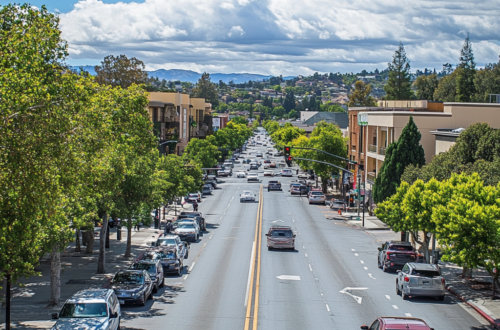
By 1970, nearly 40,000 called it home, and whole neighborhoods went up around a downtown that took its modern shape.
Two decisions drove the surge. The 1951 opening of Broadway Shopping Center, later renamed Broadway Plaza, made the city a retail hub for central Contra Costa County.
Then, in 1973, BART reached Walnut Creek.
The ride to downtown San Francisco dropped under 40 minutes, and housing tracts spread across the valley. It wasn’t a farm town anymore.
Open Space and a Modern Downtown
As growth accelerated, the city made choices that set it apart from other suburbs. In 1974, the Walnut Creek Open Space Foundation launched a conservation effort that now protects more than 3,000 acres.
Those acres span Lime Ridge, Shell Ridge, Acalanes Ridge, and Sugarloaf. Locals treat them as the city’s backyard, and the trails stay busy on weekends. It’s the kind of open land most suburbs traded away decades ago.
By ratio, few cities in Contra Costa County have set aside more open land per resident.
Downtown kept building, too. Broadway Plaza expanded, the Lesher Center for the Arts opened in 1990, and the new library followed in 2010.
The 2021 downtown plan doubled down on that mix, pushing pedestrian-friendly streets and housing above shops.
Walnut Creek Today
Estimates put the population near 70,000, and the median home price tops $1.2 million.
The city is still wrestling with the tension that’s run through the rancho era. Housing affordability, traffic on I-680, and downtown density all press one question: how much more can fit?
Voters affirmed the Urban Limit Line in the June 2026 primary, and it will shape the city’s edges for generations.
| Era | Years | Key events |
|---|---|---|
| Rancho Era | 1834–1850 | Mexican land grant to the Pacheco family; cattle ranching on 18,000 acres |
| Pioneer Settlement | 1850–1914 | Slusher and Hough arrive; “The Corners” becomes Walnut Creek; railroad arrives 1891 |
| Early City | 1914–1945 | Incorporation; population ~500; agriculture economy; Walnut Festival begins |
| Postwar Boom | 1945–1973 | Broadway Shopping Center opens 1951; BART arrives 1973; population surges to 40K |
| Modern City | 1974–present | Open space preservation; Lesher Center; Broadway Plaza expansion; ~70K residents |
Da Mayor’s Take
Slusher and Hough never set out to found a city. They built a cabin and a hotel because that is where the road crossed the creek. Everything since — the railroad, the plaza, the open space — is a footnote to one sensible decision.
The story isn’t over. Walnut Creek marks its incorporation anniversary every Oct. 21.
The Walnut Creek Downtown Association still carries the harvest tradition that began with the Walnut Festival.
For the deeper record, you don’t have to guess: the Contra Costa County Historical Society keeps the archives. The broad timeline lives on Wikipedia.
Closer to home, I’ve already traced the town’s full history and its downtown transformation. Know something I should cover? Reply or DM.
Last updated October 2026.



One comment on “From Rancho to Retail: The 175-Year Evolution of Walnut Creek”
Comments are closed.